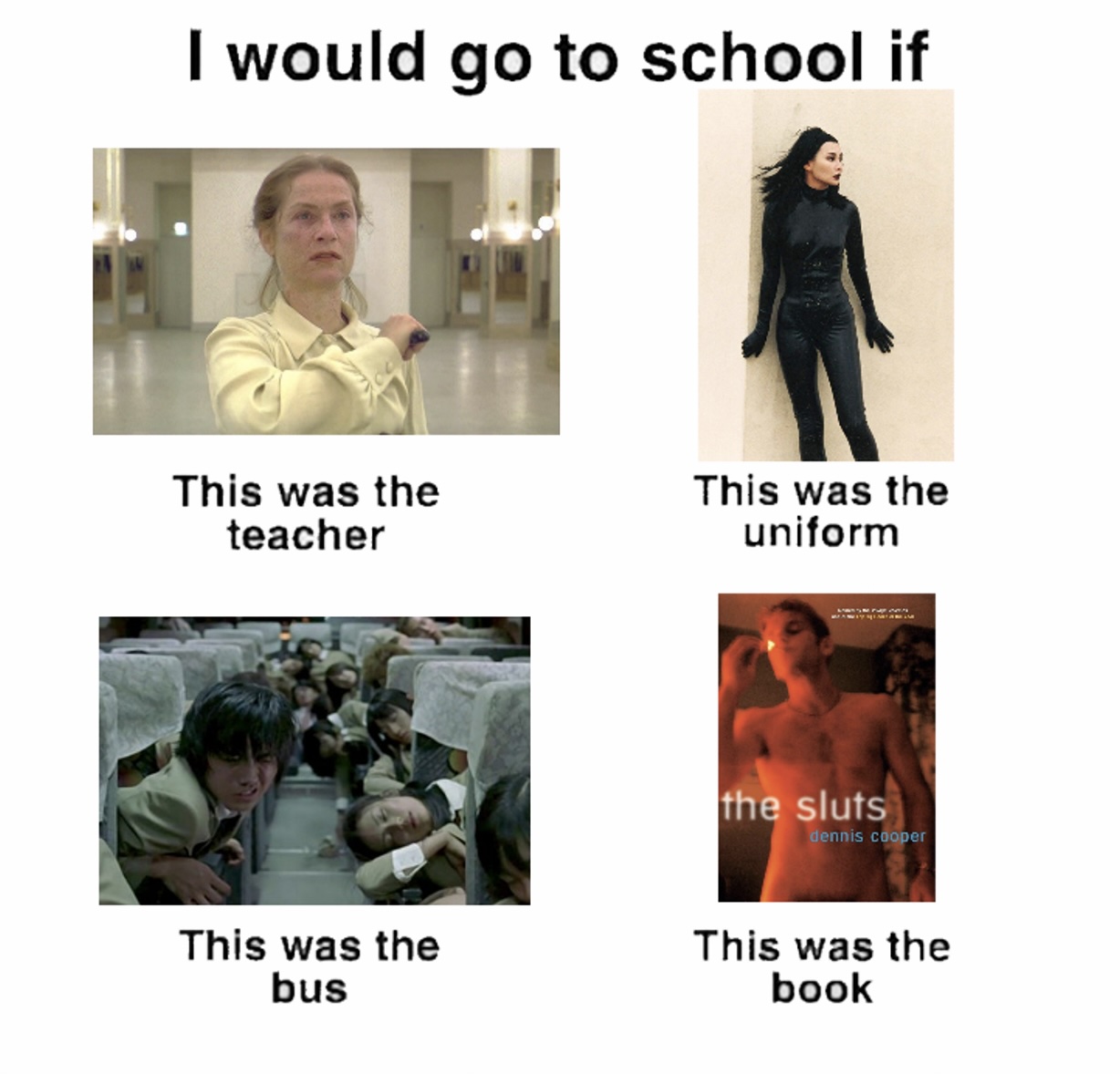
My first encounter with the Instagram meme account, @ROTGRL, was in 2019. It was through the ‘Suggested Posts’ feature that the app deposits once you have scrolled for far too many hours and have reached the end of your curated timeline. The image followed the semi-popular, “I would go to school if…” post format that had been going around, which consisted of a collage of images to describe the user’s idealised educational environment, largely based on pop culture references. The ROTGRL version in particular listed Isabelle Huppert’s character in The Piano Teacher as the teacher; the bus that the ill-fated students wake up on in Battle Royale as the mode of transport; the latex costume from Irma Vep as the uniform, and Dennis Cooper’s seminal internet fable, The Sluts, as a studied text.
I was sixteen, and I was enthralled by it. A little dark and a little left field, the post was the perfect concoction of cultural signalling, with niche enough touch points that piqued all of my teenaged filmic and literary interests. I had finally stumbled across an online community that joked about the weird shit I felt alone in enjoying. Naturally, like a moth to a flame, I reposted the image and followed the account. Thus commencing my casual devotion to the anonymous author that was ROTGRL and her notorious podcast, Fucsimile, where she posited her most polarising views on art and cultural happenings. The sardonic ROTGRL persona flourished through Fucsimile – the few utterances of a disembodied, pitched-down voice were taken as gospel by her alt-pop culture apostles, kickstarting discourse that proliferated across platforms, where she was cited religiously. ROTGRL solidified her legitimacy as a voice in contemporary culture by interviewing high profile figures – from notable independent filmmakers to top social media influencers. However, I, among others, progressively became disillusioned with ROTGRL’s increasingly incoherent political leanings (namely, her anti-capitalist values paired with her appraisal of figures such as Elon Musk, and her constant pleas to have him on the podcast). I was fatigued by the endless and repetitive conversations surrounding cancel culture and the ails of progressivism. I had almost entirely forgotten about the self-proclaimed, “three-time cancellation survivor” and the people’s internet princess. Despite this, I remained dutifully preoccupied by the question – who was behind ROTGRL?
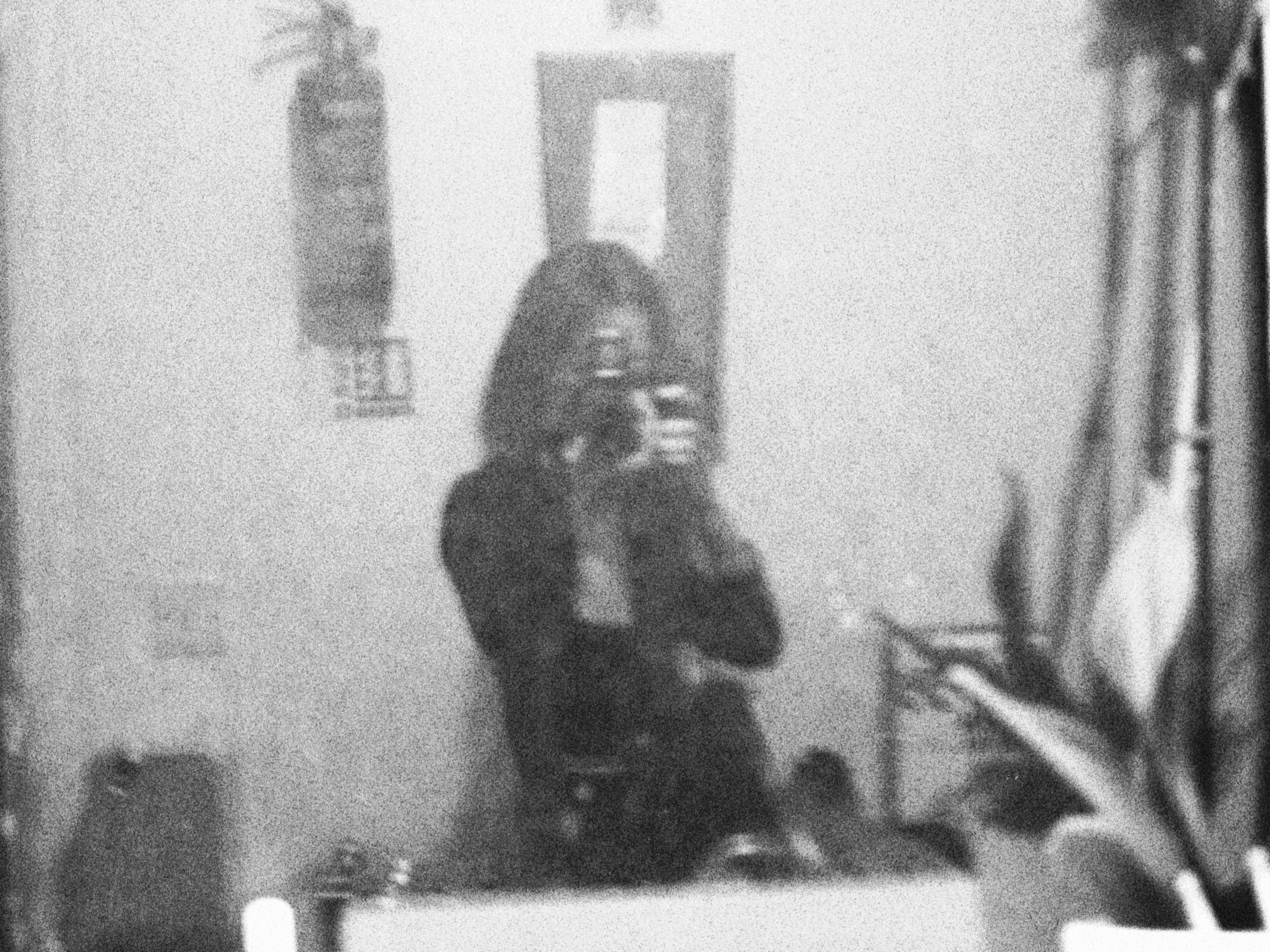
Now, in 2024, ROTGRL is across from me at a nondescript café in Bloomsbury, London. In place of a digitally mosaiced fairytale character, sits a small, sunglasses-clad woman named Annie Kano. The same woman who, six months ago, revealed herself to be the face behind the enigmatic ROTGRL persona with just an uncaptioned selfie. Casually beautiful, racially ambiguous, with long dark hair and spacey eyes – she isn’t so dissimilar to how her followers, including myself, had speculated. When I ask Kano what led to her interest in being interviewed for a student project, by an undergraduate writer no less, she takes a long, wordless pause that feels less on the awkward end and more like a controlled statement. She simply breaks it with, “Why not?”
Kano is no longer just ROTGRL; she is an underground phenomenon, and the most famous person online that you may never have heard of, and until recently, never would have laid eyes upon. Since unmasking, she has taken the niche micro-celebrity mantle by its horns – with features on Dazed Magazine and i-D, and shoutouts from buzzy stars, such as Charli xcx, or supermodel-slash-internet darling, Alex Consani. Lauded as a visionary and an inimitable presence in the alternative art world, you would suppose that Kano’s rise to prominence is owed to her eagle-eyed forecasting of trends and sharp musings on creativity in a media-saturated world. Her detractors, on the other hand (and there are many of them), describe her as a bitter opportunist who roleplays as a subversive artist.
On Kano’s announcement post for her debut feature documentary, Rotten Apples (2024), one X user comments:
X userannie kano hid behind anonymity for yrs to spread lukewarm problematic takes without any consequences and now she is LARPing as some sort of transgressive post-woke filmmaker... so predictable
Another writes:
X userInfluencers thinking that they r artists will always be the joke of the century
Seemingly, Kano’s foray into filmmaking isn’t her first brush with such criticism. In fact, part of what makes Kano fascinating, both pre and post-anonymity, is the mythology that surrounds her. From her days at art school; her meme page and the Fucsimile podcast; to her current, and more serious endeavour as a filmmaker, Kano has encapsulated something essential about the time we are living in – a moment where authorship feels as unstable as truth.
On Fucsimile, Kano was a floating, omniscient voice – diagnosing today’s culture with incisive remarks, often bordering on vulgarity. She hotly poked fun at the hypocrisies of gender representation in Western media, and the effect of neoliberalism’s inherent bias towards capitalism on the entertainment industry. There was never an introduction, no branded sponsorships, no production. The absence of Kano, the author, is what made the character of ROTGRL so compellingly real.
Roland Barthes’ seminal idea posited that the author’s intentions are rendered obsolete once a text is produced, famously declaring that “the birth of the reader must be at the cost of the death of the author”. Kano’s anonymity, on its surface, exemplifies this idea. She became a canvas on which her audience could project their own summations of what she was trying to say, and who she really was. Despite her absence being key, Kano complicates Barthes’ central thesis. If the author is truly dead, how does one explain the cult of personality that amassed around ROTGRL? Literary theorist John Frow’s work on authorship presents a relevant counterpoint, stating that, “Authorship is not the characteristic of a person but a function defined by historically specific […] conditions of existence”, which in this case would be the 21st century online sphere. Where a Barthesian reading of ROTGRL would emphasise the erasure of Kano as an author of her own output in favour of her audience’s interpretive freedom, Frow’s theory suggests that, “anonymity is never simply an absence of authorial function”. Her listeners’ construction of her did not replace her, instead, they partially invented her. The amalgam created by the ROTGRL persona, her Instagram page, and the lived experience of the listener meant that ROTGRL was a co-authored project, only conceivable in today’s digital world.
The instant Kano reinstated her authorial function through her de-anonymity, she was met with both vitriol and celebration. The audacious act, to her audience, was both a betrayal and an evolution. I broached the topic of: why now? This was question she had so vehemently avoided answering in the last six months.
Kano: If I’m being real, most of the negative reactions are pretty accurate. At my core, I am a filmmaker and performer. An artist. Of course, I want to be taken seriously. I had a premonition of submitting to like Sundance or whatever, and the image of “Directed by ROTGRL” flashing up felt super loser-ish. It all became a tad bit cringey for me. And my art outside of that role has always been to lead with some semblance of radical honesty. It’s a 180, sure. Anonymity and scarcity of self, turning into unadulterated, full confessional blitz.
The “full confessional blitz” and “radical honesty” she points to can be traced back to her days at the University of Arts London, where her approach to creativity often toed the line between pushing boundaries and exploitation, at the expense of her personal relationships and her academic success. Her most discussed works included: showing up to an assessment without work to present and recreating the previous student’s performance from memory; a visual installation that screened her tutors and classmates’ digital footprint: childhood photos extracted from family Facebook accounts, old Tweets, dating profiles, private Instagram stories; her controversial graduate performance, which was an exposing reenactment of Kano’s real-life romantic affair with her best friend’s boyfriend, both of whom were in the audience, with the former learning of the grim details in real time. It is this graduate performance that would become the subject of Kano’s autofictional, debut “anti-documentary”, Rotten Apples.
In Rotten Apples, Kano employed real names in the script, and cast a surprisingly significant amount of the actual people involved at the time. Most notably, the unfaithful boyfriend, played by the real-life Josh Browne. It seemed that Kano managed to win back the hearts of her art school comrades, bar Alice, the best friend (who has refused to comment for this article). The role was filled by an actress who bears a striking resemblance to her.
“The fallout was immediate and hellish,” Kano reveals to me, “I was subject to, like, a low-level version of the amount of flogging I get now off of total strangers. Except it was from literally everyone I ever knew.” She was socially isolated and a target of online cyberbullying within her school community after being briefly suspended from her course, which had been a devastating result for Kano as a student on scholarship. She was later reinstated on appeal.
Kano believes that revisiting this emotional turmoil through the medium of film could be meaningful and healing for all three of its central subjects. Early reviews have hailed Rotten Apples as a “lo-fi masterpiece”, and a model for “radical vulnerability in art”. In true ROTGRL fashion, the film has also drawn intense criticism – receiving a one-star rating from the Roger Ebert blog, as well as scathing takedowns of Kano’s “innate narcissism” and the film’s continuation of the “gossipy self-aggrandising” that had likely caused the original controversy. Additionally, disparaging comments online have been leveraged at the film’s production for its general apathy towards consent and making a spectacle out of an event that was likely traumatic for those involved. “Which is hilarious,” Kano notes when I bring this up to her, “considering I was very much reporting from the ground. It wasn’t like I was stealing this story, I was the story”.
Unsurprisingly, Kano upholds similar attitudes towards the current state of internet culture. She has been an enthusiastic commentator on what she calls a “period of hashtags and overcorrection” – she points to the infographic age of the post-MeToo, post-BLM years. Kano specifically interrogates what she believes is a disingenuous focus on identity politics by creative industries both within her cryptic memes and her more outwardly critical monologues on Fucsimile.
Kano: God, I’ve always been told I’m not allowed to engage in this or that discourse. I don’t fit cleanly into these identities, so suddenly I’m not allowed to comment, let alone shitpost about anyone I don’t look like? I think taking on the ROTGRL anonymity at the time allowed me to really share what I was seeing in the world, in the same way that I am challenging myself to do now as a filmmaker – because that’s what it all is, an observation. And I could post these observations as ROTGRL because you cannot put someone in a box without a face or physiognomy that you could ascribe an identity or ideology to.
In spite of Kano’s unflinching defence and her insistence upon art for art’s sake, both in her online spheres and in her filmmaking, her claims raise muddy questions around the ethics of authorship and narrative ownership. It is indeed possible that, once again taking on Barthes’ theoretical perspective, her intentions for Rotten Apples become irrelevant, and that the meaning of her film lies in the eye of the beholder. Yet, what does this mean for the real people who are inextricably tied to her work? Frow observes that, “the figure of the author is broader than that of the implied author, but both emerge through an interpretive process”. He also cites writers of autofiction, such as Rachel Cusk and Maggie Nelson, for their self-thematisation. Similarly, Kano’s film positions her as both subject and author – an interpretive figure whose life is balanced through creative transgressions and audience reaction. Extreme self-thematising can tip into an ostentatious carving out of a self-brand, or exploiting your own vulnerability for some kind of capital – in Kano’s case, artistic capital. Though, Frow reiterates that, even on these occasions, the author remains an interpretive construct: “Biographies are themselves always interpretations of life rather than simple factual records”. In turn, Rotten Apples is less a record of past events than a reconstruction of meaning, inviting its audience to interrogate the fidelity of the story to truth and the legitimacy of Kano’s authorship.
Annie Kano’s existence today is a paradox that can be navigated through the theoretical tension between Barthes’ concept and Frow’s ideas on relational authorship; the tension between the death of ROTGRL and her inevitable resurrection within public consciousness. When I tell her about the theorists I want to incorporate in this article, she gives me an impassive nod, “The Barthes link makes sense. And the other guy too. Two things can be true at once. I can’t claim ownership of my work, just like I can’t claim ownership of my image. But that doesn’t mean I don’t have to live with both.”
With the world she has built around herself, perhaps inadvertently, Annie Kano is not just an artist, a podcaster, or an author. She is a distillation of our weird and wonderful present – a time where authorship is not entirely dead but is mutating and becoming scattered.
I thank her for her time, and lastly, ask her what’s next for ROTGRL.
She laughs, “I don’t know. A lawsuit?”